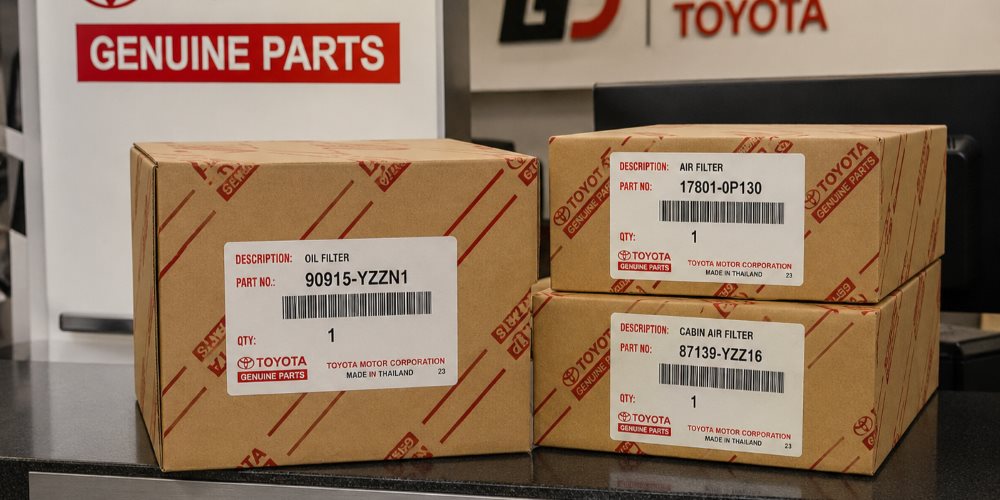
Toyota of Downtown Chicago is a factory-authorized Toyota dealer in Lincoln Park (formerly Toyota of Lincoln Park), operated by Murgado Automotive Group. Our Toyota-trained technicians install Genuine Toyota Parts and use the Toyota Diagnostic Tester (Techstream) and OEM tooling for every model we service, from the Corolla to the RAV4 Hybrid to the bZ4X. This guide reflects what we see at our parts counter and in our service bay every week. Last reviewed June 2026.
For most Toyota owners, Genuine Toyota (OEM) parts and quality aftermarket parts both have a legitimate place - the right choice depends on the part and how long you plan to keep the car. Genuine Toyota Parts are made or specifically approved by Toyota, fit exactly, reflect the latest factory design revision, and carry a 12-month Replacement Parts Limited Warranty regardless of mileage (parts and labor when a Toyota dealer installs them). Aftermarket parts vary widely in quality and are often a fine, affordable choice for wear items. The two things that shift the math in Chicago: road salt and sub-zero winters punish corrosion-exposed and electrical parts hardest, and that's exactly where lower-cost aftermarket parts may use different materials, coatings, or manufacturing standards. And no - using aftermarket parts does not automatically void your Toyota warranty. Questions on a specific repair? Call our parts and service team at (872) 353-8943.
Below we cover what "OEM," "Genuine Toyota Parts," "OE/OES," and "aftermarket" actually mean, an honest head-to-head, the warranty facts (including the Magnuson-Moss myth), why Chicago's salt belt and winters change which parts are worth buying genuine, what Toyota's Technical Service Bulletins mean for the part you get, and a plain category-by-category guide to when OEM matters and when aftermarket is perfectly fine.
What "OEM," "Genuine Toyota Parts," and "Aftermarket" Actually Mean
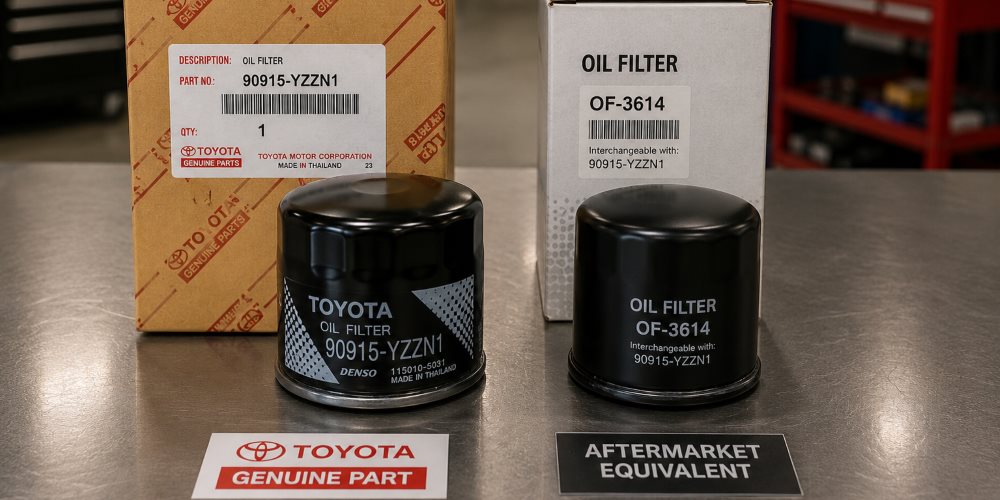
The labels get used loosely, so here's the precise version. OEM stands for Original Equipment Manufacturer - the part your Toyota was built with at the factory, made to Toyota's exact specifications. Genuine Toyota Parts are Toyota's branded OEM parts: components manufactured or specifically approved by Toyota Motor Corporation and sold through authorized Toyota dealers. For most consumers, Genuine Toyota Parts are OEM parts. However, some OEM suppliers also sell equivalent parts under their own branding.
There's a middle category most guides skip. OE/OES (Original Equipment Supplier) parts are made by the same third-party supplier that produces the component for Toyota - a Denso sensor or an Aisin water pump, for example - but sold without Toyota's branding and box. The hardware is often identical, sometimes at a lower price, but may not always reflect the latest Toyota part supersession or packaging revision. Then there's aftermarket: parts made by companies not affiliated with Toyota, designed to fit and function similarly. Aftermarket quality ranges from genuinely excellent (premium specialist brands) to poor (no-name economy parts). Toyota's own performance and accessory lines - TRD parts and Genuine Toyota Accessories - carry warranty terms similar to OEM replacement parts.
| Type | Who makes it | Toyota parts warranty? | Best for |
|---|---|---|---|
| Genuine Toyota Parts (OEM) | Made or approved by Toyota | Yes, 12 months, any mileage | Safety, electronics, drivetrain, anything under warranty |
| OE / OES | Toyota's supplier, sold unbranded | No (supplier's own warranty) | A middle ground on out-of-warranty repairs |
| Premium aftermarket | Reputable specialist brands | No (brand's own warranty) | Many wear items; budget-conscious repairs |
| Economy aftermarket | No-name / low-cost manufacturers | No (often minimal) | Cosmetic or low-stakes parts only - use caution |
OEM vs. Aftermarket: The Honest Head-to-Head
We're a Toyota dealer, so you'd expect us to say "always buy OEM." We won't. Here's the straight comparison, including where aftermarket genuinely wins.
| Factor | Genuine Toyota (OEM) | Aftermarket |
|---|---|---|
| Fit & precision | Exact match - designed for your VIN's configuration | Usually close; occasional fitment or tolerance issues |
| Quality consistency | Uniform to Toyota spec | Excellent to poor depending on brand |
| Warranty | 12-month Toyota parts warranty (parts + labor if dealer-installed) | Varies by maker; often shorter and narrower |
| Latest design revision | Reflects Toyota's most recent updated part (see TSB section) | Typically copies the original design |
| Cost | Higher than economy aftermarket; often comparable to premium aftermarket | Can be the cheapest option, especially economy lines |
| Availability | Ordered through a dealer; same-day on common parts, otherwise short wait | Broadly stocked at parts stores - often faster |
| Records & resale | Documented OEM may support resale value and can simplify certain service-contract claims | Fine, but some extended warranties require OEM |
The fair summary: aftermarket's real advantages are price and availability, and the best aftermarket brands are genuinely good. OEM's advantages are exactness, the latest revision, and the warranty umbrella. Which set of advantages matters more depends entirely on the part - which is the rest of this guide.
Does Using Aftermarket Parts Void Your Toyota Warranty?
This is the single most common myth we hear, so let's settle it. No - installing an aftermarket part does not automatically void your Toyota warranty. Under a federal law called the Magnuson-Moss Warranty Act, a manufacturer cannot void your vehicle's warranty simply because you used an aftermarket part or had service done somewhere other than a dealer.
There's an important limit. If a specific aftermarket part directly causes a specific failure, Toyota can deny that particular claim - but the burden of proof is on the manufacturer to show the aftermarket part caused the problem. The rest of your warranty stays intact. Two practical notes that follow from this: damage caused to a Toyota component by a non-genuine part isn't covered, and many extended warranties and vehicle service contracts do require Genuine Toyota Parts for claims. If you use an independent shop, ask for OEM parts where it matters and keep your receipts. (This is general information, not legal advice - we're technicians, not attorneys.)
The Toyota Genuine Parts Warranty - What's Actually Covered
Here's what the Genuine Toyota Parts warranty covers, in plain terms. The headline is a 12-month Replacement Parts Limited Warranty that applies regardless of mileage - but how you buy and install the part changes what's covered.
| How you buy/install | What's covered |
|---|---|
| Bought & installed by a Toyota dealer | 12 months, any mileage - parts and labor (or the remainder of the New Vehicle Limited Warranty, whichever is longer) |
| Bought over the counter, installed elsewhere | 12 months - parts only; labor is not covered |
| 12V batteries | An exception - their own battery warranty, typically longer when installed by a dealer (ask the parts department for current terms) |
| Tires | Warranted by the tire manufacturer, not Toyota |
A couple of things worth knowing: wear-and-tear items such as brake pads, clutch components, and wiper blades are generally excluded from the parts warranty, and warranty terms can change. The simplest way to keep both parts and labor under one warranty is to have the work done where the part is installed. For current, vehicle-specific terms, confirm with our parts department or your warranty booklet.
Why This Matters More for Chicago Drivers
Most OEM-versus-aftermarket advice online is written as if every car lives in a mild, dry climate. Chicago is not that. Three local realities - the salt belt, sub-zero winters, and pothole-cratered streets - put stress on the exact parts where economy aftermarket parts most often cut corners. This is consistent with what we see on Chicago's roads, and it's the part of this decision a generic guide can't tell you.
Road salt and corrosion
Illinois treats roads aggressively with both rock salt and calcium chloride brine, and on Lake Shore Drive and the expressways your undercarriage takes the brunt of it all winter. Salt accelerates corrosion on brake lines, fuel-line and brake hardware, sensor connectors (wheel-speed/ABS and oxygen sensors), exhaust hangers and heat shields, and undercarriage fasteners.Genuine Toyota Parts are manufactured to Toyota's corrosion-resistance specifications for these components; economy aftermarket parts sometimes save money exactly there, and in the salt belt may affect long-term durability in severe winter environments. On Tacoma, Tundra, and 4Runner models especially, salt-belt undercarriage condition is something our technicians inspect closely, and it's an area Toyota has addressed through service campaigns over the years.
Sub-zero winters and your 12V battery
Chicago winters routinely drop below 0°F, and cold is brutal on batteries - it raises the cranking effort the battery has to deliver while reducing its available capacity. A properly sized battery that meets Toyota specifications generally performs better in severe cold than an undersized battery. Hybrid models add a wrinkle: their 12V auxiliary battery is spec-sensitive, so matching the correct battery matters more, not less. Genuine Toyota batteries and a free battery inspection with any service are an easy way to get ahead of it.
Potholes, freeze-thaw, and suspension parts
Chicago's freeze-thaw cycle cracks pavement into the potholes every driver here knows, and they're hard on suspension and steering components - control arms, bushings, struts, wheel bearings, and TPMS sensors. Fitment precision matters on these parts: a control arm or bushing that's slightly off-spec can affect alignment, tire wear, and ride quality. This is a category where the exactness of OEM (or a top-tier specialist brand) earns its keep, and where a bargain part can cost you an extra alignment.
Short-trip downtown driving, filters, and fluids
If your week is mostly short hops - Lincoln Park to River North, the Loop, the Grove - your engine rarely reaches full operating temperature, and city dust, pollen, and lakefront humidity load your filters faster than a highway commuter's. Cabin and engine air filters and oil filters all have a Toyota-specified filtration and flow rating; OEM filters meet it, and they're inexpensive enough that the savings on an economy filter rarely justify the unknowns. See our pages on the cabin air filter, engine air filter, and oil filter.
What Toyota's TSB Updates Mean for the Part You Get
Here's something only an authorized dealer's parts counter can really speak to. When Toyota identifies a way to improve a component, it issues a Technical Service Bulletin (TSB) and often supersedes the old part number with an updated revision. Order that part as a Genuine Toyota Part through a dealer and you get the latest revision - the improved design.Some aftermarket parts are based on earlier designs and may not always incorporate updates reflected in later Toyota part revisions. Across the vehicles that come through our service bay, updated revisions have covered things like cooling-system components, weather seals, and sensor designs; we won't cite specific bulletin numbers here because they change, but the principle is consistent.
Fitment isn't the whole story, either. Some parts pair with a calibration step our Toyota Diagnostic Tester (Techstream) performs - the Toyota Safety Sense windshield camera, for example, needs recalibration after a windshield replacement, and certain sensors must be initialized to work correctly. Genuine parts plus that calibration keep Toyota Safety Sense and the Star Safety System behaving the way they were designed to. The same goes for hybrid and electric models: traction-battery service, inverter coolant, and high-voltage components are areas where OEM specification and OEM tooling matter, and we use Genuine Toyota Parts on the Camry Hybrid, RAV4 Hybrid, Prius, Highlander Hybrid, RAV4 Prime, and bZ4X.
One caution on "OEM" sold online: counterfeit parts marketed as genuine are a real problem, and safety components like airbag and SRS parts are a known concern. If you're buying parts yourself, buy from an authorized Toyota dealer or parts source so you know what you're actually getting.
Which Parts to Buy OEM and When Aftermarket Is Fine
Pushing every driver toward Genuine parts for everything isn't honest, and it isn't how we'd advise our own families. Here's the category-by-category version.
| Part category | Our recommendation | Why |
|---|---|---|
| Safety-critical (brake friction, steering, suspension, SRS/airbag) | OEM or premium brand - never no-name | Performance and consistency directly affect safety |
| Sensors & electronics (O2, ABS, cameras, TPMS) | OEM strongly preferred | Compatibility and calibration; salt-belt connector corrosion |
| Engine/drivetrain internals, cooling, hybrid components | OEM | Tight tolerances; benefits from the latest TSB revision |
| Filters (oil, engine air, cabin air) | OEM or reputable premium | OEM is inexpensive and spec-matched; little to gain going cheaper |
| 12V battery | OEM-spec (TrueStart) or a quality, correctly-sized equivalent | Chicago cold punishes undersized batteries |
| Wear & cosmetic (wiper blades, mats, bulbs, accessories) | Quality aftermarket is fine | Low stakes and OEM wiper inserts are inexpensive here anyway |
| Tires | Buy quality tires, correctly sized and rated | Toyota does not manufacture its own tires. Vehicles are equipped with OEM-specified tires supplied by major tire manufacturers. |
And to be clear about shops: if your Toyota is out of warranty, you're doing routine maintenance, and you have a trusted independent mechanic using quality parts, that's a perfectly reasonable choice -especially on a vehicle you're keeping only a short while. Keep your receipts either way.
What Genuine Toyota Parts Cost in Chicago
Genuine parts usually cost more than economy aftermarket and are often in the same ballpark as premium aftermarket; OE/OES parts can land below dealer OEM for similar hardware. Rather than quote moving numbers, we publish current parts and service offers on our specials pages, and a few that come up often for parts-related visits:
- Toyota Sightline wiper blades: $15.99 each, installation included (2017-2025 Toyotas).
- Battery inspection: free with any other service, and 15% off a new manufacturer battery.
- Wild Card discount: 10% off a $100–$249 visit, 12% off $250–$499, 15% off $500–$999.
- Happy Hour: 15% off regularly priced services for Monday–Friday appointments between 2:00 and 5:00 PM.
Pricing as of June 2026; visit our service specials and parts specials pages for current offers, restrictions, and applicable models. For a written estimate on a specific repair or part, call (872) 353-8943.
Frequently Asked Questions
Is OEM the same as Genuine Toyota Parts?
For your Toyota, effectively yes. "OEM" means the part is made to the automaker's original specification, and Genuine Toyota Parts are Toyota's branded OEM parts - manufactured or specifically approved by Toyota and sold through authorized dealers.
Will aftermarket parts void my Toyota warranty?
Not automatically. Under the federal Magnuson-Moss Warranty Act, a manufacturer can't void your warranty just because you used an aftermarket part or serviced your car elsewhere. They can deny one specific claim only if they prove a specific aftermarket part caused that failure and the rest of your warranty stays intact.
Is there a warranty on Genuine Toyota Parts?
Yes - a 12-month Replacement Parts Limited Warranty regardless of mileage. Parts installed by a Toyota dealer are covered for parts and labor; parts bought over the counter and installed elsewhere are covered for parts only. 12V batteries and tires have their own separate terms.
Are aftermarket parts safe?
Quality varies enormously. Reputable specialist brands can be excellent, while no-name economy parts can be inconsistent. We'd steer clear of economy aftermarket on safety, sensor, and critical drivetrain components, and we're comfortable with quality aftermarket on many wear items.
Which parts should I always buy OEM?
Safety-critical parts (brakes, steering, suspension, airbag/SRS), sensors and electronics, engine and drivetrain internals, cooling components, and hybrid/EV components. These are where exact fit, the latest design revision, and compatibility matter most.
Are OEM parts more expensive than aftermarket?
Usually more than economy aftermarket, but often comparable to premium aftermarket. OE/OES parts - the same supplier's hardware sold without Toyota branding - can be a lower-cost middle ground, though they don't carry Toyota's parts warranty.
What are OE or OES parts?
They're parts made by the same supplier that produces the component for Toyota (a Denso or Aisin part, say), sold without Toyota's box and branding. The hardware is often identical, but they aren't backed by Toyota's parts warranty and may not be the latest revision.
Do OEM parts last longer?
Often, and the gap tends to be widest exactly where Chicago is hardest - corrosion-exposed and electrical parts in the salt belt, and batteries in deep cold. For low-stakes items the difference is smaller. It depends on the specific part.
Does Toyota make its own tires and batteries?
Toyota doesn't make tires - it specifies tire brands and sizes, and tires are warranted by their manufacturer. Batteries are sold as Toyota's OEM-spec TrueStart line, supplied to Toyota's standard; the key is getting the correct battery for your vehicle, which matters a lot in Chicago winters.
Can I keep my Toyota warranty if I service it at an independent shop?
Yes. The same Magnuson-Moss protection applies to where you service the car. Keep your maintenance records and receipts, follow the maintenance schedule, and ask for OEM parts where it matters.
Genuine Toyota Parts & Service in Chicago
Whether you want Genuine Toyota Parts installed by a Toyota-trained technician or just a straight answer on whether OEM is worth it for your repair, our Lincoln Park team can help. You can book online, our Toyota Express Maintenance lane handles routine work quickly, and a Monday–Friday appointment between 2:00 and 5:00 PM takes 15% off regularly priced services with our Happy Hour Special.
Service Department: (872) 353-8943
Service Hours: Monday–Friday 7:00 AM – 7:00 PM | Saturday 8:00 AM – 5:00 PM | Sunday Closed
1561 N Fremont St, Chicago, IL 60642 (Lincoln Park)
Parts warranty terms and pricing vary by part, model, and how the part is installed, and are subject to change. Offer terms and expiration dates may change without notice - verify current offers directly on our parts specials and service specials pages before scheduling. For coverage specific to your vehicle, consult a certified Toyota technician at Toyota of Downtown Chicago.
About Toyota of Downtown Chicago Service Center
Toyota of Downtown Chicago is a factory-authorized Toyota dealer serving Chicago and Cook County, operated by Murgado Automotive Group from 1561 N Fremont St in Lincoln Park (formerly Toyota of Lincoln Park). Our service department is staffed by Toyota-trained technicians using the Toyota Diagnostic Tester (Techstream) and Genuine Toyota Parts for every Toyota - including hybrid (Camry Hybrid, RAV4 Hybrid, Prius, Highlander Hybrid), plug-in hybrid (RAV4 Prime), and electric (bZ4X) models. New Toyota purchases include ToyotaCare, covering 2 years / 25,000 miles of factory-scheduled maintenance at no charge. Our Toyota Express Maintenance lane handles oil changes, tire rotations, and inspections in a fraction of the time of a traditional service visit.
This guide reflects parts and service patterns observed in our Chicago service bay and is intended as educational information, not legal or warranty advice. Warranty terms and pricing references are representative as of June 2026 and subject to change; confirm current details with our parts department. Published June 8, 2026 · Last reviewed June 8, 2026.
