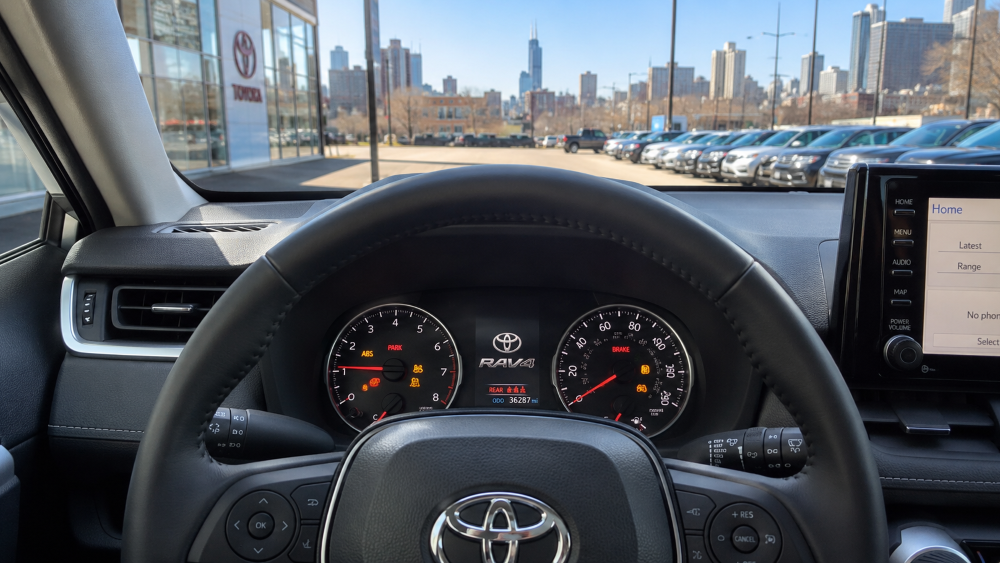
This guide covers the most common Toyota dashboard warning lights by color, what each symbol means, and which ones Chicago drivers see more often than drivers in milder climates - including hybrid-specific warnings for Prius, RAV4 Hybrid, RAV4 Prime, and Highlander Hybrid owners.
Toyota Warning Light Colors: The Priority System
| Color | Urgency | What to Do |
|---|---|---|
| Red | Immediate attention required | Stop driving as soon as it is safe to do so. Some red lights indicate conditions that can cause rapid engine damage if ignored. Do not continue driving until the cause is identified. |
| Amber / Yellow | Service needed soon | The vehicle can generally continue operating, but service should be scheduled promptly. Extended driving with an amber light can allow a minor issue to develop into a more significant one. |
| Green | System active / informational | No action needed. Green lights confirm a feature (turn signal, cruise control, AWD lock) is currently active. |
| Blue | Informational | High beam headlights are on. No action needed unless you intend to turn them off. |
| White | System status | Appears on some newer Toyota multi-information displays for system notifications. Context-dependent - check your owner's manual. |
Red Toyota Warning Lights: Stop and Act
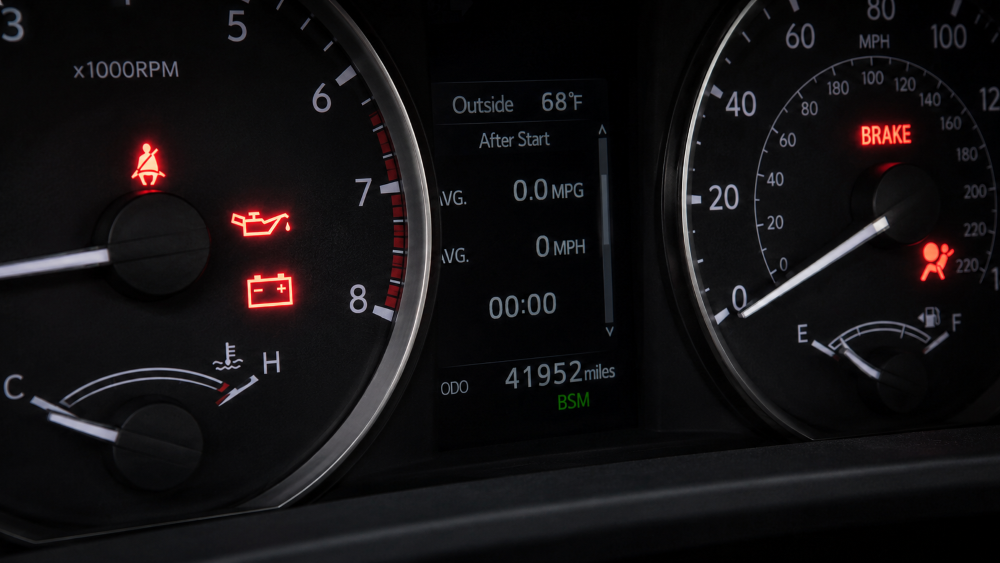
Safety note: Any red warning light that appears while driving should be taken seriously. If you are on Lake Shore Drive, the Kennedy (I-90/94), or in stop-and-go traffic on Michigan Avenue when a red light comes on, move to the right lane and find a safe place to stop as soon as possible. Do not continue until you have identified the cause.
Oil Pressure Warning Light (red oil can symbol)
One of the most critical warning lights on any Toyota. Low oil pressure means the engine is not receiving adequate lubrication - continued driving can cause severe and irreversible engine damage within minutes. Stop the engine as soon as it is safe to do so and check the oil level. If the oil level is normal but the light remains on after restarting, do not drive the vehicle. This indicates a possible oil pump failure or internal leak requiring Techstream diagnosis.
Chicago-specific note: Sub-zero cold starts in January and February are a common trigger for brief oil pressure warnings. If the light appears at startup on a cold morning and extinguishes within a few seconds as oil circulates, monitor it. If it persists beyond startup or recurs, treat it as a genuine warning and schedule inspection promptly.
Engine Coolant Temperature Warning (red thermometer symbol)
The engine is overheating. Stop driving immediately and allow the engine to cool before opening the hood. Do not remove the radiator cap when the engine is hot. Common causes include a coolant leak, failed thermostat, or water pump failure. In Chicago, this light can appear after extended stop-and-go traffic in summer heat on the Dan Ryan or the Eisenhower.
Battery Warning Light (red battery symbol)
The charging system is not maintaining battery voltage - typically a failing alternator, loose or corroded battery cable, or failed drive belt. The vehicle may continue running briefly on battery power alone, but electrical systems will begin to fail as the battery drains. This is not the same as a low-battery notification; it means the battery is actively discharging while driving. Chicago winters accelerate battery terminal corrosion, which can contribute to charging faults even when the alternator is functioning.
Brake System Warning Light (red circle with exclamation, or BRAKE text)
If this light appears while driving with the parking brake released, it typically indicates low brake fluid - often from worn brake pads or a fluid leak in the brake system. Do not ignore this light. Pull over safely and do not drive until the brake system has been inspected. Road salt accelerates corrosion of brake lines and calipers on Chicago vehicles, particularly those with more than 60,000 miles.
Hybrid System Warning Light or Master Warning Indicator (hybrid models)
On Prius, Camry Hybrid, RAV4 Hybrid, RAV4 Prime, Highlander Hybrid, and Sienna models, a hybrid-system fault may trigger a Master Warning indicator - often shown as a red or amber triangle with an exclamation point, depending on model year and display design - together with a message in the multi-information display. The vehicle may enter a limited-operation mode or, in some cases, lose propulsion. Pull over safely, read the displayed message, and contact a qualified service professional. Toyota-specific diagnostic equipment such as Techstream may be required to identify the underlying fault; a basic generic OBD-II reader may not retrieve all hybrid-system codes or sub-codes.
Amber Toyota Warning Lights: Schedule Service
Check Engine Light (amber engine outline symbol)
The check engine light - technically the Malfunction Indicator Lamp (MIL) - indicates the engine management system has detected a fault and stored a Diagnostic Trouble Code (DTC). A steady amber light means the fault is present but not immediately dangerous. A flashing check engine light indicates active misfiring and should be addressed promptly - misfires can damage the catalytic converter rapidly.
Common Toyota DTC codes include P0420 and P0430 (catalyst efficiency), P0171 and P0174 (lean fuel trim), P0301-P0306 (cylinder misfires), and P0011/P0010 (variable valve timing). A generic OBD-II reader can retrieve the code number, but accurate diagnosis requires Toyota Techstream access and model-specific knowledge.
Master Warning Light (amber triangle with exclamation point)
Toyota's Master Warning indicator is a general alert rather than a diagnosis by itself. Unlike the Check Engine Light, the Master Warning Light is not itself a diagnostic trouble code; it appears with a message in the multi-information display (MID) describing the condition that needs attention. Depending on the model and year, triggers can include low washer fluid, an open door, low fuel, or another vehicle-system notification. Read the MID message first. Our Toyota Maintenance Required Light guide explains the difference between MAINT REQD and the Master Warning Light.
TPMS Warning Light (amber tire cross-section with exclamation)
One or more tires is significantly under-inflated (typically 25% or more below the recommended pressure). In Chicago this light appears most often in November - the first significant cold snap causes tire pressure to drop approximately 1 PSI per 10 degrees Fahrenheit - and again in spring when the freeze-thaw pothole cycle causes slow leaks or sudden deflation. Check all four tires with a gauge before assuming the sensor is faulty. A TPMS light that stays on after correct inflation may indicate a damaged sensor from pothole impact.
VSC / TRAC OFF Light (amber car with wavy lines)
Vehicle Stability Control and Traction Control have been manually disabled or a fault has been detected. Some Chicago drivers disable TRAC intentionally on snow and ice to allow controlled wheel spin when stuck. If these lights appear without deliberate input, have the system inspected - VSC and TRAC faults can affect ABS as well.
Maintenance Required Light (amber MAINT REQD or wrench symbol)
A mileage-based service reminder, not a fault indicator. It illuminates at 5,000-mile intervals after the last reset and must be manually reset after each service. For a full explanation of what triggers it, how to reset it, and why Chicago drivers often see it return earlier than expected, see our dedicated Toyota Maintenance Required Light guide.
Dashboard Warning Lights Chicago Drivers See More Often
Chicago's climate and road conditions create a specific pattern of warning light triggers that our Lincoln Park service bay commonly observes - not unique to Chicago, but occurring at notably higher frequency here than in warmer or drier markets.
Battery and charging warnings after Chicago winters
A battery that performs normally in October may fail to start the car in January below 0°F. Battery performance drops significantly in extreme cold, and an aging battery may cross the failure threshold during a Chicago cold snap. Battery and charging concerns are therefore more common in January and February. Ask the Toyota of Downtown Chicago service team about current battery inspection options and available battery specials when scheduling.
TPMS lights from pothole season
Chicago's freeze-thaw cycle generates significant pothole conditions from late winter through spring. A hard pothole strike on North Avenue, Clybourn, or Western Avenue can cause immediate tire deflation, bend a wheel rim, or damage a TPMS sensor. A TPMS light that appears suddenly after hitting a pothole warrants a tire and wheel inspection, not just an inflation check.
Oil pressure warnings on sub-zero cold starts
Cold-thickened oil takes slightly longer to circulate at startup in extreme cold, which can trigger a brief oil pressure warning. This is more common on higher-mileage vehicles or vehicles that have exceeded their oil change interval. If the light extinguishes within a few seconds and does not return, monitor it. If it persists or recurs, schedule inspection promptly. See our Toyota oil change guide for Chicago drivers for guidance on winter-appropriate oil change intervals.
Hybrid system notifications in extreme cold
Prius, RAV4 Hybrid, RAV4 Prime, Camry Hybrid, and Highlander Hybrid owners may see hybrid system notifications in extreme cold, particularly when the traction battery has been sitting in sub-zero temperatures for an extended period. The hybrid system may limit electric-only operation until the battery reaches operating temperature - this is generally normal behavior. A persistent hybrid warning light or a "Ready" indicator that fails to illuminate should be diagnosed promptly.
Toyota Warning Lights by Model
Toyota Camry dashboard warning lights
The 2018+ Camry (TNGA-K platform) displays most warnings in the multi-information display. The Toyota Safety Sense (TSS 2.5+) system has its own indicators for pre-collision warning, lane departure alert, and adaptive cruise control status. A TSS warning light often indicates camera or radar sensor obstruction - in Chicago, snow, ice, or road salt spray on the windshield camera housing is a common cause. Cleaning the area around the forward camera often resolves it.
Toyota RAV4 dashboard warning lights
The 2019+ RAV4 is the model for which we receive the most warning light questions in our service bay. The RAV4 Hybrid and RAV4 Prime have additional hybrid system indicators. One RAV4-specific note: the "ENGINE MAINTENANCE REQUIRED" message on some 2019-2021 RAV4 models is distinct from the standard MAINT REQD light - it indicates a specific engine system notification rather than a routine mileage reminder. See our MAINT REQD guide for the full breakdown.
Toyota Corolla dashboard warning lights
The 2020+ Corolla uses the multi-information display for most warning messages. The amber wrench icon on the 2014-2019 Corolla serves the same function as MAINT REQD on newer models. The exclamation point in a circle on the Corolla is most commonly the Master Warning indicator or the tire pressure warning - check the MID for the accompanying text message before drawing conclusions.
Toyota Prius & Prius Prime dashboard warning lights
The Prius has additional hybrid-specific indicators not found on conventional vehicles. The green "READY" indicator must illuminate before the Prius can be driven - if it does not appear after you press the Power button, the hybrid system may not have initialized correctly. A Master Warning indicator, often accompanied by a message in the instrument display, may indicate a hybrid-system fault requiring Toyota-specific diagnosis. The 2023+ fifth-generation Prius displays most system information digitally rather than through traditional analog gauges.
Toyota Tacoma & 4Runner dashboard warning lights
Tacoma and 4Runner owners may see 4WD or differential lock indicators when the transfer case is engaged - these are informational, not faults. The TPMS warning is particularly relevant for Tacoma owners in Chicago because the higher ground clearance increases exposure to road debris that can damage sensors. A rear differential lock indicator (amber) should be disengaged when returning to normal road driving.
When to Come In vs. When to Handle It Yourself
Handle it yourself first: TPMS light (check and inflate tires to door jamb spec), low fuel warning (add fuel), MAINT REQD after a recent oil change (reset per our MAINT REQD guide), Master Warning with a "low washer fluid" MID message (add washer fluid), high beam indicator (check stalk position).
Schedule service soon: Steady amber check engine light, VSC/TRAC fault, TPMS light that persists after correct inflation (indicates slow leak or sensor damage), Maintenance Required light (schedule the service, do not just reset and ignore).
Stop driving and call: Any red warning light, a flashing check engine light, hybrid system warning on a Prius or hybrid RAV4, brake system warning with the parking brake released, oil pressure warning that persists beyond cold startup, engine coolant temperature warning.
Frequently Asked Questions
What does the yellow exclamation point mean on a Toyota?
A yellow exclamation point on a Toyota can indicate one of three different warnings depending on its location and shape. A circle with an exclamation point is typically the brake system or tire pressure warning. A triangle with an exclamation point is the Master Warning indicator - check the multi-information display for the accompanying message. The text "MAINT REQD" is the routine maintenance mileage reminder. Your owner's manual identifies each symbol specifically for your model and year.
Is it safe to drive with an amber warning light on?
Generally yes - amber means schedule service soon rather than stop immediately. The exception is a flashing amber check engine light, which indicates active misfiring and should be addressed promptly to prevent catalytic converter damage. When in doubt, call our service advisors at (872) 353-8943 to assess the specific light and any accompanying symptoms before continuing to drive.
Why did my TPMS light come on overnight in Chicago?
Temperature drop is the most common cause. Tire pressure decreases approximately 1 PSI for every 10-degree Fahrenheit drop in ambient temperature - a significant overnight temperature drop in Chicago from October through April can push tire pressure below the TPMS threshold without any puncture. Check all four tires with a gauge and inflate to the door jamb specification. The TPMS light should reset automatically after driving at speed for a few minutes once pressures are correct.
Can a generic OBD-II reader diagnose my Toyota check engine light?
A generic OBD-II reader can retrieve the DTC code number. This tells you which system is involved and is a useful starting point. However, generic readers do not access the Toyota-specific enhanced data that Techstream provides - including live sensor data, freeze frame information, and Toyota-specific sub-codes essential for accurate diagnosis. A code number is not the same as a diagnosis.
My Toyota hybrid shows a "Ready" light but then goes off. What does that mean?
The green "READY" indicator on Prius and other Toyota hybrids confirms the hybrid system has initialized and the vehicle is ready to move. If it illuminates and then goes off unexpectedly, the hybrid system has detected a fault and entered a protection mode. Do not attempt to drive the vehicle. This requires Techstream diagnosis to identify the specific fault - hybrid system codes are not accessible with standard OBD-II readers.
Does Toyota of Downtown Chicago diagnose warning lights without an appointment?
Our Toyota Express Maintenance lane handles routine service without a traditional appointment, but warning light diagnosis typically requires scheduling a service appointment so a Toyota-trained technician can allocate appropriate time with Techstream. For urgent red warning lights, contact our service team - the number is in the scheduling section below - and we can advise on the best next step based on the specific light and any accompanying symptoms.
Schedule a Warning Light Diagnosis in Chicago
If a warning light has appeared on your Toyota's dashboard and you are uncertain what it means or what to do next, our Toyota-trained technicians can diagnose it accurately using Toyota Diagnostic Tester (Techstream). We service all Toyota models including hybrid and plug-in hybrid vehicles, and we can check for any open recalls at the same visit.
Service Department: (872) 353-8943
Service Hours: Monday-Friday 7:00 AM - 7:00 PM | Saturday 8:00 AM - 5:00 PM | Sunday: Closed
Schedule service online | View current service specials
Warning light descriptions in this guide are intended as general educational information. Actual causes and recommended service actions vary by vehicle model, year, trim, and condition. Consult a Toyota-certified technician at Toyota of Downtown Chicago for diagnosis specific to your vehicle. Offer terms and pricing subject to change - verify current specials at our service specials page before booking.
About Toyota of Downtown Chicago Service Center
Toyota of Downtown Chicago is a factory-authorized Toyota dealer serving Chicago and Cook County, operated by Murgado Automotive Group from 1561 N Fremont St in Lincoln Park (formerly Toyota of Lincoln Park). Our service department is staffed by Toyota-trained technicians using Toyota Diagnostic Tester (Techstream) and OEM tooling required for accurate diagnosis of every Toyota - including hybrid (Camry Hybrid, RAV4 Hybrid, Prius, Highlander Hybrid), plug-in hybrid (RAV4 Prime, Prius Prime), and electric (bZ4X) vehicles. New Toyota purchases include ToyotaCare, which generally provides complimentary factory-scheduled maintenance for 2 years or 25,000 miles, whichever comes first, on eligible new Toyota vehicles. Coverage and eligibility vary by model year and program terms.
This guide reflects diagnostic patterns commonly observed in our Chicago service bay and is intended as educational information. For diagnosis specific to your vehicle, consult a Toyota-certified technician. Published 2026-06-22 · Last reviewed 2026-06-22.
