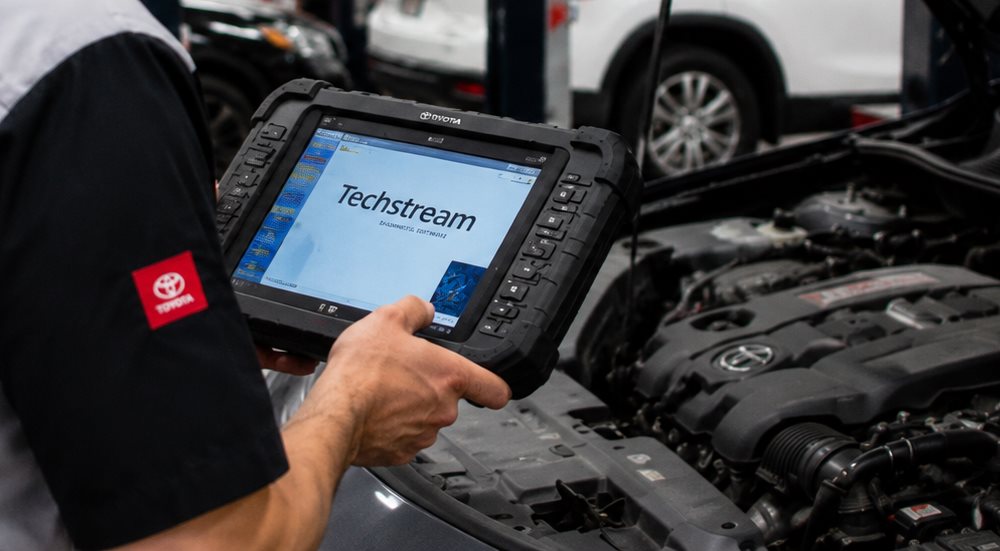
Toyota of Downtown Chicago Service Center is a factory-authorized Toyota dealer at 1561 N Fremont St in Lincoln Park, operated by Murgado Automotive Group. Our Toyota-trained technicians use Toyota Diagnostic Tester (Techstream), Genuine Toyota Parts, and Toyota-specified fluids for every service. New Toyota purchases include ToyotaCare - 2 years / 25,000 miles of complimentary factory-scheduled maintenance. Our Toyota Express Maintenance lane handles routine services efficiently. Last reviewed May 2026.
A certified Toyota technician is a mechanic who has completed Toyota's factory training programs including, in many cases, the T-TEN (Technician Training & Education Network) program and holds Toyota-specific certifications on top of industry-standard ASE credentials. The difference between a certified Toyota technician and a general mechanic isn't about basic skill. It's about access: access to Toyota's proprietary diagnostic tools, access to Technical Service Bulletins before they become public knowledge, access to Genuine Toyota Parts engineered for exact-fit applications, and the ongoing factory training required to maintain certification on evolving systems like Toyota Safety Sense 3.0 and Toyota Hybrid System II.
For Chicago Toyota owners specifically, the gap matters more than in most markets. Sub-zero winters, aggressive road salt, freeze-thaw pothole cycles, and short-trip urban driving create wear patterns that generic service manuals don't address but that experienced Toyota technicians in our Lincoln Park service bay recognize because they see them repeatedly. Here are five specific benefits, followed by an honest look at when a certified technician isn't necessary.
1. Factory Training on Toyota-Specific Systems
Toyota vehicles use proprietary technologies that general mechanics encounter less frequently and may not have trained on specifically. Toyota Safety Sense (TSS 3.0 and TSS 2.5+) relies on a windshield-mounted camera and radar module that require recalibration after windshield replacement - a procedure that demands Toyota-specific tooling and calibration targets. The Toyota Hybrid System (THS II) in the Camry Hybrid, RAV4 Hybrid, Highlander Hybrid, Prius, and Crown uses a high-voltage traction battery, inverter, and motor-generator set that require specialized safety protocols and diagnostic knowledge. The TNGA platform (TNGA-K, TNGA-C, TNGA-F) introduced structural and suspension geometry changes that affect alignment specifications differently across model generations.
Toyota-certified technicians receive ongoing factory training through Toyota's Professional Development program. This isn't a one-time course - it's continuous education that tracks Toyota's engineering changes across model years. When a new model launches or a system is updated, certified technicians receive training before the vehicles reach the service bay. General mechanics typically learn about these systems from aftermarket training resources, which may lag behind by months or years.
Toyota's T-TEN program, active since 1986, has graduated nearly 12,000 students through partnerships with community colleges and technical schools across the U.S. Graduates earn both ASE certifications and Toyota-specific technician credentials.
2. Access to Toyota Diagnostic Tester (Techstream)
Techstream is Toyota's proprietary diagnostic platform - the same system Toyota engineers use to develop and validate vehicle systems. It provides deeper access to Toyota-specific data than aftermarket scan tools in several meaningful ways.
What Techstream does that generic tools often can't:
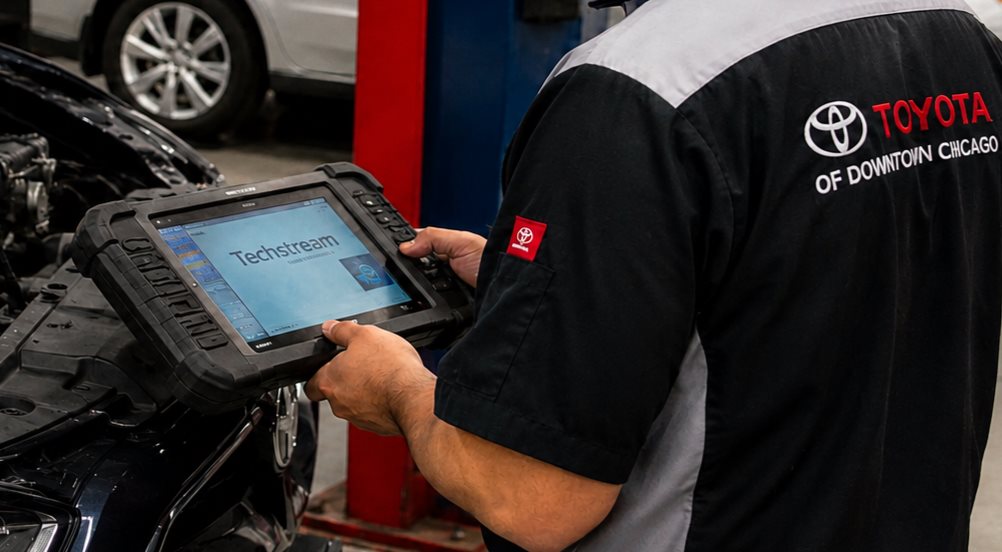
Techstream reads and clears Toyota-specific diagnostic trouble codes (DTCs) that aftermarket scanners may not recognize - particularly on hybrid systems, Toyota Safety Sense modules, and the Smart Key/immobilizer system. It performs active tests on individual components (injectors, solenoids, actuators) to isolate failures that passive code-reading misses. It accesses Toyota's Technical Service Bulletin database directly, cross-referencing your VIN against known issues and factory-recommended fixes. And for hybrid vehicles, Techstream provides traction battery health data - individual cell voltage readings, state of charge, and degradation metrics - that aftermarket tools typically can't access.
In a Chicago context, this matters most during winter diagnostic scenarios. Sub-zero cold starts generate a cascade of temporary DTCs - oxygen sensor heater codes, EVAP system codes, and hybrid battery temperature warnings - that experienced technicians recognize as cold-weather artifacts rather than genuine failures. Without Techstream's freeze-frame data and Toyota-specific code definitions, a general shop may recommend unnecessary repairs based on codes that would clear on their own once temperatures normalize.
Note: Aftermarket scan tools have improved significantly and many competent independent shops use professional-grade equipment that covers the majority of standard diagnostics. Techstream's advantage is most pronounced on Toyota-specific systems - hybrids, TSS calibration, Smart Key, and immobilizer programming — rather than on routine engine or transmission codes that are standardized across manufacturers.
3. Genuine Toyota Parts vs. Aftermarket
Certified Toyota technicians at factory-authorized dealers install Genuine Toyota Parts — components engineered, tested, and validated specifically for your Toyota model. The difference between genuine and aftermarket parts ranges from negligible (wiper blades, air filters) to significant (brake components, engine sensors, hybrid system parts).
Where Genuine Toyota Parts make a meaningful difference for Chicago drivers:
Brake pads and rotors: Toyota's OEM brake compounds are formulated for the specific weight, braking dynamics, and ABS/VSC calibration of each model. Aftermarket brake pads vary widely in compound quality some perform well, others generate more dust, noise, or premature rotor wear. In Chicago's stop-and-go traffic on the Kennedy, Lake Shore Drive, and I-290, brake systems work harder than in suburban highway driving.
Oxygen sensors and emissions components: Aftermarket O2 sensors sometimes trigger persistent check engine lights (P0420, P0430) on Toyotas because their response curves don't precisely match Toyota's ECU calibration. A Genuine Toyota sensor eliminates this compatibility issue.
Hybrid-specific components: Traction battery cells, inverter coolant, and hybrid transaxle fluid are areas where aftermarket substitutes may not meet Toyota's specifications. These aren't components to experiment with - the cost of getting it wrong is measured in thousands, not tens of dollars.
Where aftermarket is generally fine: oil filters (provided they meet Toyota's flow and bypass specifications), cabin air filters, engine air filters, wiper blade inserts, and most lighting components. A certified technician can advise on which components warrant genuine parts and where a quality aftermarket alternative is a reasonable choice.
4. Warranty, ToyotaCare, and Recall Coverage
This is the benefit that has the most direct financial impact for newer Toyota owners.
ToyotaCare (2 years / 25,000 miles): Every new Toyota includes ToyotaCare, covering factory-scheduled maintenance - oil changes, tire rotations, multi-point inspections, and fluids at no charge for the first 2 years or 25,000 miles. This maintenance must be performed at a Toyota dealership to be covered under the program. For Chicago owners who purchased their Toyota from Toyota of Downtown Chicago, this means your 5,000-mile, 10,000-mile, 15,000-mile, and 20,000-mile services are already paid for.
Factory warranty protection: While federal law (Magnuson-Moss Warranty Act) does not require you to service your vehicle exclusively at a dealer to maintain your warranty, having service performed by a certified Toyota technician using Genuine Toyota Parts creates a clear, documented service history that makes warranty claims straightforward. If a covered component fails and Toyota's warranty department reviews your service records, factory-authorized service history eliminates ambiguity about whether proper procedures, fluids, and parts were used.
Recall coverage: Toyota recalls are performed exclusively at factory-authorized dealers, at no cost to the owner. Certified technicians follow Toyota's specific recall procedures which sometimes differ from what seems intuitive - and document completion in Toyota's national database. At Toyota of Downtown Chicago, we check for open recalls during every service visit.
Toyota Service Care ($450 prepaid): For owners past the ToyotaCare window, Toyota Service Care covers 5 scheduled maintenance visits (described by Toyota as 5 oil changes and 5 tire rotations) at $90 per service, plus 2 years of roadside assistance. Note that the actual service scope at each visit depends on your model's maintenance schedule — vehicles on a 10,000-mile oil change interval may receive a tire rotation and inspection rather than a full oil change at the 5,000-mile mark. Your service advisor can clarify what each visit includes for your specific Toyota.
5. Chicago-Specific Diagnostic Pattern Recognition
This is the benefit that no certification program formally teaches - and that competing "benefits of certified technicians" articles don't cover.
Experienced Toyota technicians in Chicago develop pattern recognition for issues that are specific to this climate and driving environment. These aren't things you'll find in the Toyota owner's manual or in generic service guides. They come from years of seeing the same failure patterns repeat across thousands of Chicago-driven Toyotas.
Salt-belt corrosion patterns: Illinois uses both rock salt and calcium chloride brine on roads. Calcium chloride is more corrosive than standard road salt and targets brake lines, exhaust hangers, sensor connectors (particularly wheel speed sensors and ABS sensors), and undercarriage fasteners. Experienced technicians at Toyota of Downtown Chicago commonly inspect for these corrosion patterns during routine services - they know where salt damage appears first on specific Toyota models, including the documented frame corrosion concern on certain model-year Tacomas and 4Runners that Toyota addressed through TSB campaigns.
Cold-start diagnostic artifacts: Sub-zero Chicago winters generate temporary diagnostic codes - oxygen sensor heater circuits, EVAP system integrity, and hybrid battery temperature warnings — that clear once the vehicle reaches operating temperature. Experienced technicians recognize these as cold-weather artifacts and avoid recommending unnecessary repairs. A technician unfamiliar with Chicago winter patterns may interpret the same codes as component failures requiring replacement.
Short-trip urban oil degradation: Lincoln Park, River North, Wicker Park, and Bucktown residents who rarely take their Toyotas to highway speeds face accelerated oil degradation from short-trip driving. The engine doesn't fully heat-cycle, moisture accumulates in the crankcase, and fuel dilution affects turbocharged engines (Camry XSE V6, RAV4 Prime, Crown turbo variants). Experienced technicians commonly observe this pattern and can assess oil condition during service rather than relying solely on the mileage-based maintenance reminder.
Freeze-thaw pothole damage: Chicago's pothole season affects wheel alignment, TPMS sensor accuracy, ball joints, tie-rod ends, and CV boot integrity. These are items that a thorough Toyota service inspection catches — and that a quick-lube oil change doesn't check.
When a Certified Toyota Technician Isn't Necessary
Honesty builds trust. Here are the services where an independent shop is a perfectly reasonable choice - and where you shouldn't feel pressured to visit a dealer.
Routine oil changes on out-of-warranty vehicles: If your Toyota is past the ToyotaCare window and not covered by an extended service plan, any shop using the correct 0W-20 full synthetic oil and a quality filter can perform a standard oil change. The oil doesn't know where it was poured.
Tire replacement and rotation: Any competent tire shop can mount, balance, and rotate tires. Toyota's tire specifications (size, load rating, speed rating) are printed on the driver's door jamb — any shop can match them. Toyota of Downtown Chicago does offer a Tire Price Match Guarantee, so it's worth checking our price before assuming the dealer is more expensive.
Brake pad replacement (standard): A standard brake pad swap on a non-hybrid Toyota is a straightforward job that most qualified independent shops handle well. Where the dealer adds value is on hybrid brake systems (regenerative braking calibration) and on vehicles with active safety systems that may need recalibration after brake work.
Cabin and engine air filter replacement: These are simple swap-in components. You can do them yourself in most cases.
Windshield replacement (without TSS): If your Toyota doesn't have Toyota Safety Sense (older models), windshield replacement is a standard job. If your Toyota does have TSS, the windshield camera requires recalibration - and that's where a dealer with Techstream becomes necessary.
Frequently Asked Questions
What is a certified Toyota technician?
A certified Toyota technician is a mechanic who has completed Toyota's factory training programs and holds Toyota-specific certifications, often in addition to ASE (Automotive Service Excellence) credentials. Many have graduated from Toyota's T-TEN program, a nationwide training partnership with community colleges and technical schools. Certification requires ongoing education to stay current with new models and systems.
Does my Toyota warranty require dealer service?
Federal law (Magnuson-Moss Warranty Act) does not require exclusive dealer service to maintain your warranty. However, if a warranty claim arises, documented service history from a factory-authorized dealer using Genuine Toyota Parts provides the clearest proof that proper procedures were followed. This can simplify and expedite warranty claims.
Is dealer service more expensive than an independent shop?
Dealer labor rates are typically higher than independent shops - that's true across all brands, not just Toyota. But the total cost difference narrows when you factor in included services (multi-point inspection, battery check, recall scan, car wash), the value of Techstream diagnostics, and promotions like the Happy Hour Special (15% off Mon–Fri 2–5 PM), Early Bird arrivals, and the Wild Card discount (10–15% off based on spend). For Toyota Service Care customers, the per-service cost is locked at $90.
What is Techstream, and why does it matter?
Techstream is Toyota's proprietary diagnostic platform - the same system Toyota engineers use during vehicle development. It provides deeper access to Toyota-specific systems (hybrid battery health, TSS calibration, Smart Key programming, Toyota-specific DTCs) than most aftermarket scan tools. It matters most for hybrid diagnostics, safety system recalibration, and complex electrical troubleshooting.
Can Toyota of Downtown Chicago service Lexus vehicles?
Toyota and Lexus are sister brands sharing many powertrains and platforms, and Toyota dealers can service Lexus vehicles in many cases. Our Toyota-trained technicians are familiar with shared systems across both brands. For Lexus-specific features or warranty work, a Lexus dealer may be required.
What's the difference between ASE certification and Toyota certification?
ASE certification is an industry-wide credential that validates general automotive knowledge across all manufacturers. Toyota certification is brand-specific, covering Toyota proprietary systems (Techstream, THS II, TSS, Smart Key, TNGA platform specifics) that ASE exams don't address. The strongest technicians hold both — ASE for broad competence, Toyota certification for brand-specific depth.
Schedule Service with Certified Toyota Technicians in Chicago
Whether it's a routine oil change, a check engine light diagnosis, or a hybrid battery health assessment, our Toyota-certified team at Toyota of Downtown Chicago has the factory training, tooling, and Chicago-specific experience to handle it accurately.
Service Department: (872) 353-8943
Service Hours: Monday–Friday 7:00 AM – 7:00 PM | Saturday 8:00 AM – 5:00 PM | Sunday: Closed
Schedule service online | View current service specials
Book a Mon-Fri 2:00-5:00 PM appointment to save 15% with the Happy Hour Special, or check whether your Toyota is still covered under ToyotaCare complimentary maintenance before scheduling.
About Toyota of Downtown Chicago Service Center
Toyota of Downtown Chicago is a factory-authorized Toyota dealer serving Chicago and Cook County, operated by Murgado Automotive Group from 1561 N Fremont St in Lincoln Park (formerly Toyota of Lincoln Park). Our service department is staffed by Toyota-trained technicians using Toyota Diagnostic Tester (Techstream) and the OEM tooling required for accurate diagnosis of every Toyota — including hybrid (Camry Hybrid, RAV4 Hybrid, Prius, Highlander Hybrid), plug-in hybrid (RAV4 Prime, Prius Prime), and electric (bZ4X) vehicles. New Toyota purchases include ToyotaCare, covering 2 years / 25,000 miles of factory-scheduled maintenance at no charge. Our Toyota Express Maintenance lane handles oil changes, tire rotations, and inspections in a fraction of the time of a traditional service visit.
This guide reflects diagnostic patterns commonly observed in our Chicago service bay and is intended as educational information. For diagnosis specific to your vehicle, consult a Toyota-certified technician. Pricing references are representative of the Chicago market as of May 2026 and subject to change. Published May 24, 2026 · Last reviewed May 26, 2026.
