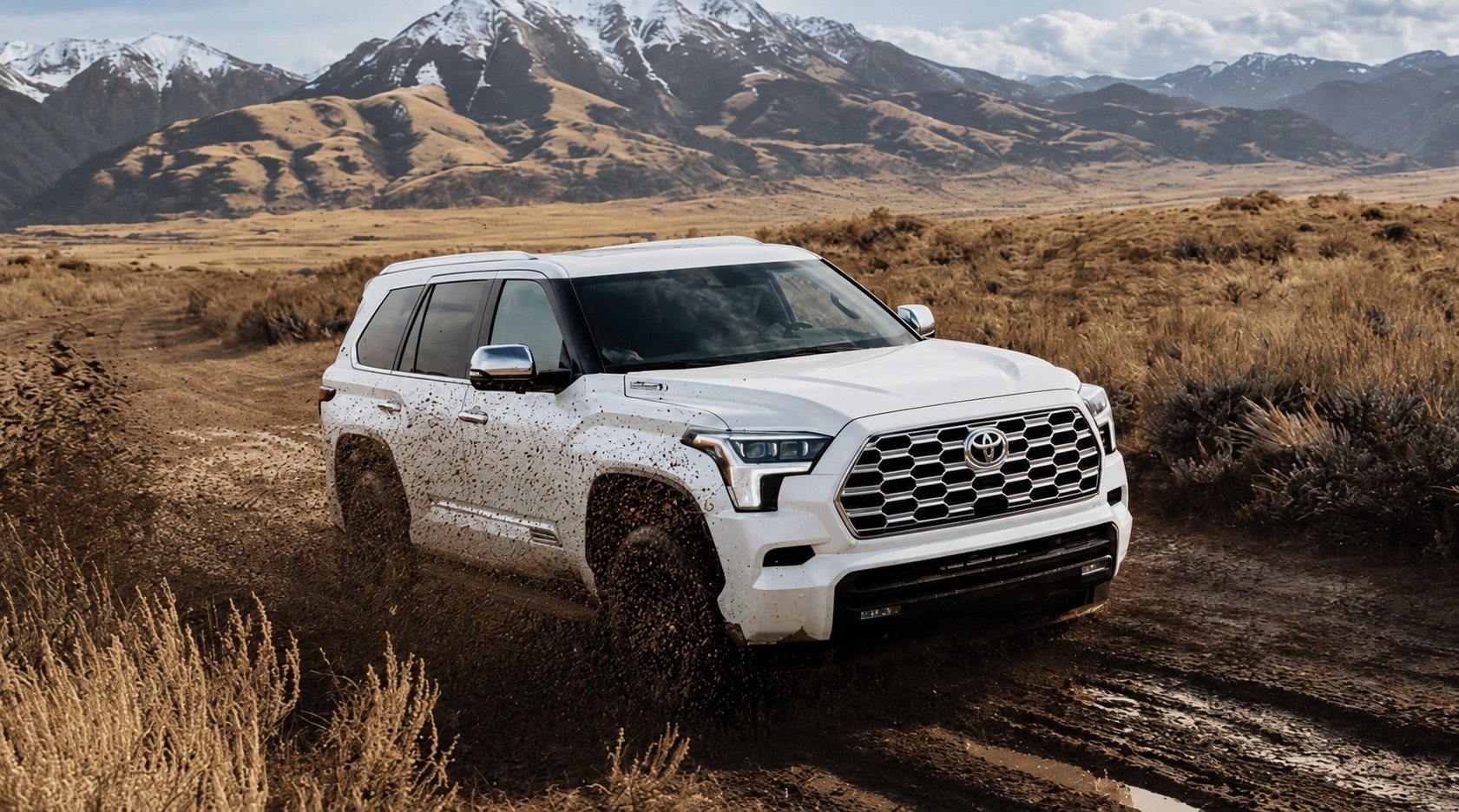
Start with your garage’s lowest clearance and the actual vehicle’s highest point. Published dimensions are useful for screening a vehicle, but they do not guarantee that it will safely pass through a particular garage.
Published October 9, 2026. Updated October 9, 2026. This guide focuses on the 2026 Toyota Sequoia.
A full-size SUV needs more than enough room under the entrance sign. Before choosing a Toyota Sequoia for a Chicago parking garage, check the opening height, interior obstructions, usable parking-space length, mirror clearance and the approach from the street or alley.
A garage posted at 6 feet 8 inches has a nominal limit of 80 inches. A 7-foot opening is 84 inches. Compare those numbers with the specific vehicle you intend to buy, including any roof accessories, tire changes and suspension equipment.
Will a Toyota Sequoia fit in a garage?
It depends on the grade, equipment and garage. Toyota’s listed stock heights for the 2026 Sequoia range from 74.5 to 78.9 inches. Those figures are below 80 inches, but the difference is only a nominal measurement margin. It is not a recommended safety allowance or a guarantee of clearance.
| Grade | Listed height | Below 80 inches | Below 84 inches |
|---|---|---|---|
| SR5 and Limited | 75.4 in. | 4.6 in. | 8.6 in. |
| Platinum, 1794 Edition and Capstone | 74.5 in. | 5.5 in. | 9.5 in. |
| TRD Pro | 78.9 in. | 1.1 in. | 5.1 in. |
Reference: Toyota’s 2026 Sequoia brochure. Calculated margins subtract the listed vehicle height from 80 or 84 inches. Confirm the dimensions and equipment of the specific vehicle before relying on these figures.
Pay particular attention to the TRD Pro. Its listed height leaves only 1.1 inches below an 80-inch limit. Do not use that nominal difference as approval to enter. Ramp transitions, uneven surfaces, overhead equipment and roof accessories can affect whether the vehicle clears.
Measure the complete route. A home garage’s lowest point may be the door mechanism, opener rail, pipe or beam. In a public parking structure, follow the posted limit and operator’s instructions. Do not enter if the actual clearance is uncertain.
How long is a Toyota Sequoia?
Toyota lists the 2026 Sequoia at 208.1 inches long, or approximately 17 feet 4 inches. A garage or stall needs additional usable space for the door to close and for people to move around the vehicle.
Measure from the inside of the closed garage door to the nearest wall, cabinet or stored object. Consider whether you need to open the liftgate inside and whether its opening path could contact a door, ceiling or beam.
Width also matters. A body-width figure alone does not establish mirror clearance or leave room to open passenger doors. Measure the actual vehicle with its mirrors in the position you will use, then compare it with the opening and parking space.
Will it make the turn into an alley garage?
Turning-circle specifications cannot predict every alley entry. The approach angle, door location, alley width and nearby fences or parked vehicles all affect how easily a full-size SUV can enter.
Check these details before buying:
- The clear width of the alley and garage opening.
- The space opposite the opening needed to begin the turn.
- Objects near the opening that could contact mirrors or bodywork.
- The available room for safe maneuvering without entering another property or obstructing traffic.
Ask whether a test-drive route can include your building or alley. Confirm adequate overhead clearance before attempting an entry; a test drive should not be used to discover whether the roof will strike an obstruction.
How much cargo space does a Toyota Sequoia have?
The sliding third row lets you trade passenger legroom for luggage space. Toyota lists 11.5 to 22.3 cubic feet behind the third row, depending on its position, 49.0 cubic feet behind the second row and up to 86.9 cubic feet behind the first row.
| Cargo configuration | Listed volume |
|---|---|
| Behind third row, seat slid fully forward | 22.3 cu. ft. |
| Behind third row, seat slid fully back | 11.5 cu. ft. |
| Behind second row | 49.0 cu. ft. |
| Behind first row | 86.9 cu. ft. |
Reference: Toyota’s 2026 Sequoia brochure. Cargo capacity varies with seat position and configuration.
Cubic feet describe volume, not the shape of the available space. Bring your stroller, luggage or other regularly carried items to check how they fit with the third row positioned for your passengers.
Toyota’s 2026 announcement identifies a power-folding third row as standard across the lineup. Check its operation and the available loading space on the vehicle you are considering.
Sequoia or Tahoe: which fits your needs better?
Compare the exact model year and configuration of each vehicle. Garage fit depends on height, length, mirrors, equipment and the approach. Cargo needs depend on how many seats you use and where those seats are positioned.
Chevrolet lists up to 122.7 cubic feet of maximum cargo space for the 2026 Tahoe, compared with Toyota’s listed maximum of 86.9 cubic feet for the 2026 Sequoia. These maximum figures require rear seats to be folded and do not describe luggage capacity with all passenger rows in use.
For a practical comparison, inspect both vehicles with the seats arranged as your family will use them. Compare the cargo opening, usable floor space, passenger access and parking visibility as well as the published dimensions.
Towing requires a separate configuration check. Maximum advertised towing capacities are not the rating for every vehicle. Confirm the specific vehicle’s rating, required equipment, payload limits, hitch limits and trailer requirements in its documentation.
Safety ratings should be compared test by test. IIHS lists the following ratings for the 2026 models:
| IIHS evaluation | 2026 Sequoia | 2026 Tahoe |
|---|---|---|
| Small overlap front | Good | Acceptable |
| Moderate overlap front: updated test | Marginal | Poor |
| Side: updated test | Good | Good |
Sources: IIHS ratings for the 2026 Toyota Sequoia and 2026 Chevrolet Tahoe. These are individual test ratings, not an overall safety ranking. See each page for test details and model applicability.
Dependability is a different question. The Chevrolet Tahoe received a model-level award in J.D. Power’s 2026 U.S. Vehicle Dependability Study. That study examines three-year-old vehicles; it does not establish the future reliability of a new 2026 vehicle or a particular VIN.
Roof rails, crossbars and rooftop cargo
Measure the highest point of the fully equipped vehicle. Do not assume that a general vehicle-height specification accounts for every installed rail, crossbar, cargo box or other accessory.
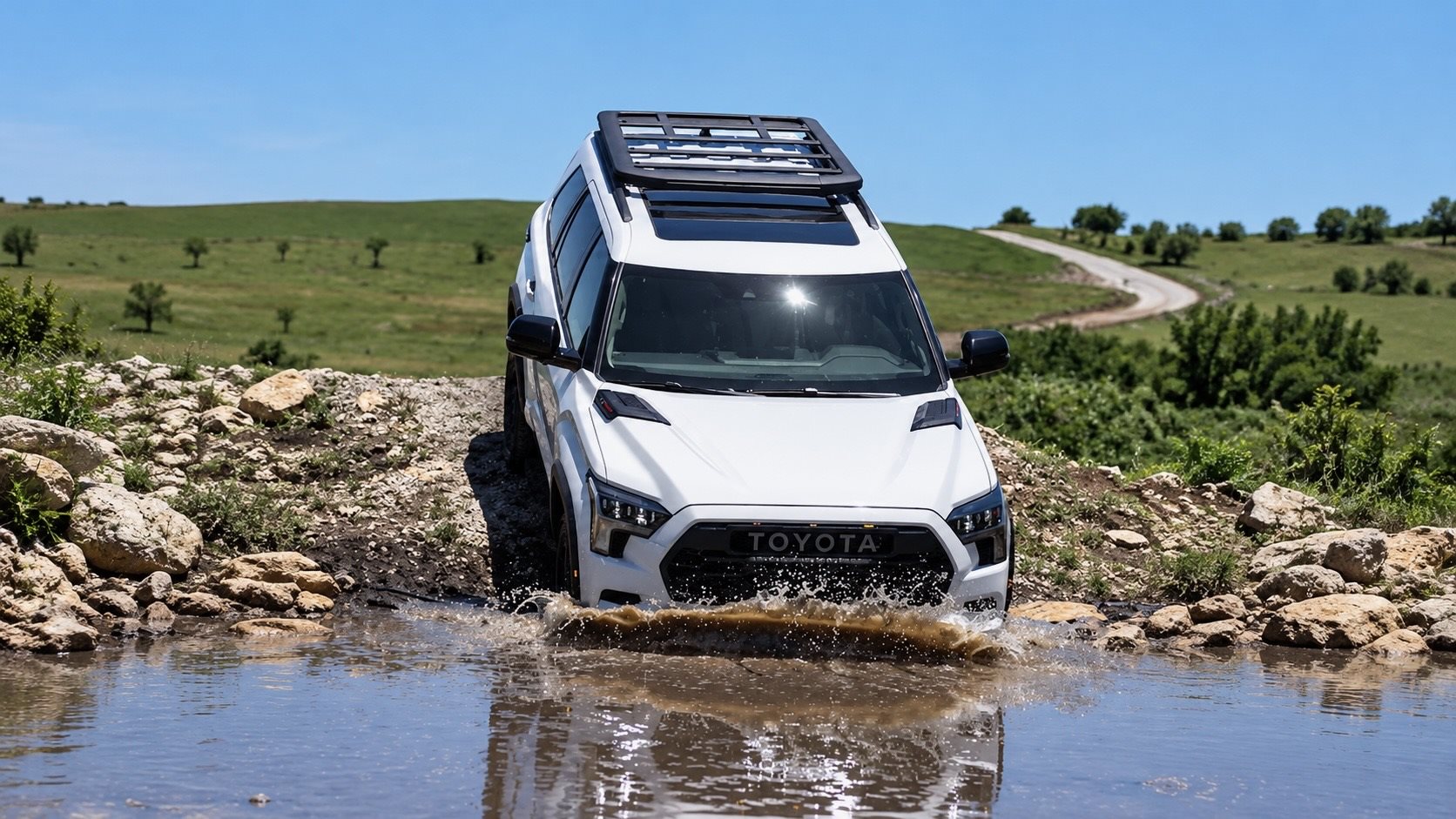
- Roof rails: Confirm their relationship to the published height for your specific configuration, or measure the vehicle directly.
- Crossbars: Check the installed height. Product dimensions alone may not describe how far the bars extend above the vehicle’s existing highest point.
- Rooftop cargo boxes: Measure with the box mounted and closed. Mounting positions can overlap, so adding separate component dimensions may give an inaccurate total.
- Bikes, kayaks and other loads: Include the tallest part of the secured load. Remove roof-mounted equipment before entering if adequate clearance cannot be confirmed.
For example, if an installed accessory raises the actual highest point by 16 inches above a measured vehicle height of 74.5 inches, the total becomes 90.5 inches. That exceeds both an 80-inch limit and an 84-inch opening. This is an illustrative calculation, not an accessory specification.
For a vehicle with adjustable suspension, follow the owner’s manual and account for any height changes. Do not assume a temporary lowered setting will remain unchanged throughout a garage entry.
When should you consider a Grand Highlander?
Consider the Grand Highlander if a smaller three-row SUV better suits your parking space and daily use. Toyota lists the 2026 Grand Highlander at 201.4 inches long and 72.1 inches tall, compared with the Sequoia’s listed 208.1-inch length.
Those dimensions make it a useful alternative to measure against your garage, but they still do not guarantee fit. Check the actual vehicle’s equipment, mirrors and highest point.
Compare the gas, Hybrid and Hybrid MAX versions separately. Their fuel-economy estimates and towing capabilities differ. Confirm the rating for the exact configuration instead of applying one figure to every Grand Highlander hybrid.
For specifications and configuration details, see Toyota’s Grand Highlander information.
Frequently Asked Questions
Will a Toyota Sequoia fit through a 7-foot garage door?
The listed stock heights for the 2026 Sequoia are below 84 inches, but that alone does not establish safe passage. Measure the actual clear opening with the door fully open, the vehicle’s highest point and any lower obstructions inside. Include accessories and consider changes in surface angle.
Does the listed vehicle width include the mirrors?
Do not assume that it does. Confirm the manufacturer’s measurement definition and measure the specific vehicle with mirrors extended or folded as appropriate. Leave enough usable room for door opening and passenger access.
What is the most common Toyota Sequoia problem?
Recall records alone cannot identify the most common owner problem or predict reliability. For a particular vehicle, review its service history and check its VIN using NHTSA’s recall lookup and Toyota’s recall and service-campaign lookup. Recall applicability and repair status vary by VIN.
Where can I find current crash-test ratings?
Review the 2026 Sequoia IIHS page and search the exact model year and configuration in NHTSA’s ratings database. The organizations use different evaluation programs. An absent rating should not be interpreted as a passing or failing result.
Is every 2026 Toyota Sequoia a hybrid?
Yes. Toyota identifies the i-FORCE MAX twin-turbo V6 hybrid as standard for the 2026 Sequoia, rated at 437 horsepower and 583 lb.-ft. of torque. See Toyota’s 2026 announcement. Earlier Sequoia generations used different powertrains.
What has Toyota announced for the 2027 Sequoia?
Toyota’s July 23, 2026 announcement describes updated exterior styling, a standard 14-inch touchscreen, standard Toyota Safety Sense 4.0 and an available Trailhunter package. Do not apply 2026 dimensions to a 2027 vehicle without checking its specifications. See Toyota’s 2027 announcement for details. Driver-assistance features have operating limitations and require an attentive driver.
See a Sequoia in Person in Chicago
Bring your garage measurements and a list of any roof accessories you plan to use. Ask the team to help you compare the specific Sequoia or Grand Highlander you are considering with your parking requirements.
Toyota of Downtown Chicago
1561 N Fremont St, Chicago, IL 60642
Sales: (877) 413-8672
Confirm current sales hours and vehicle availability before visiting.
Published specifications are reference figures and may vary by configuration. Actual vehicle height and clearance can be affected by tires, accessories, suspension settings, loading and surface conditions. Measure the specific vehicle and the complete garage route before entering. Calculated differences are not guaranteed safe-clearance allowances. Cargo capacity varies with seat position and configuration. Towing capability depends on the specific vehicle, equipment and loading; consult its documentation. Inventory, hours and offers are subject to change. Confirm availability and review all applicable offer terms and expiration dates with the dealership.
About Toyota of Downtown Chicago
Toyota of Downtown Chicago is located at 1561 N Fremont St in Chicago. Contact the dealership for current Toyota inventory, vehicle information and assistance comparing available configurations.
By Toyota of Downtown Chicago. Published October 9, 2026. Updated October 9, 2026.
